Start with three facts: the longest piece, the thickest piece and the narrowest point on the route to the loading area. A wide pile photograph alone does not show whether a limb can pass through a gate or turn around an air-conditioning unit.
Do a safety check before touching the pile
Look up before moving any limb. OSHA says tree work near energized lines requires qualified line-clearance workers, and its guidance treats power lines as energized until proven otherwise. If a branch or tool could come within 10 feet of a line, do not cut or carry it yourself. For a downed line, stay away and contact 911 and NV Energy.
Leave lodged limbs, bent branches under pressure and overhead pieces alone. This guide is about organizing debris already resting safely on the ground, not tree cutting or storm-response work.
Record size without risky handling
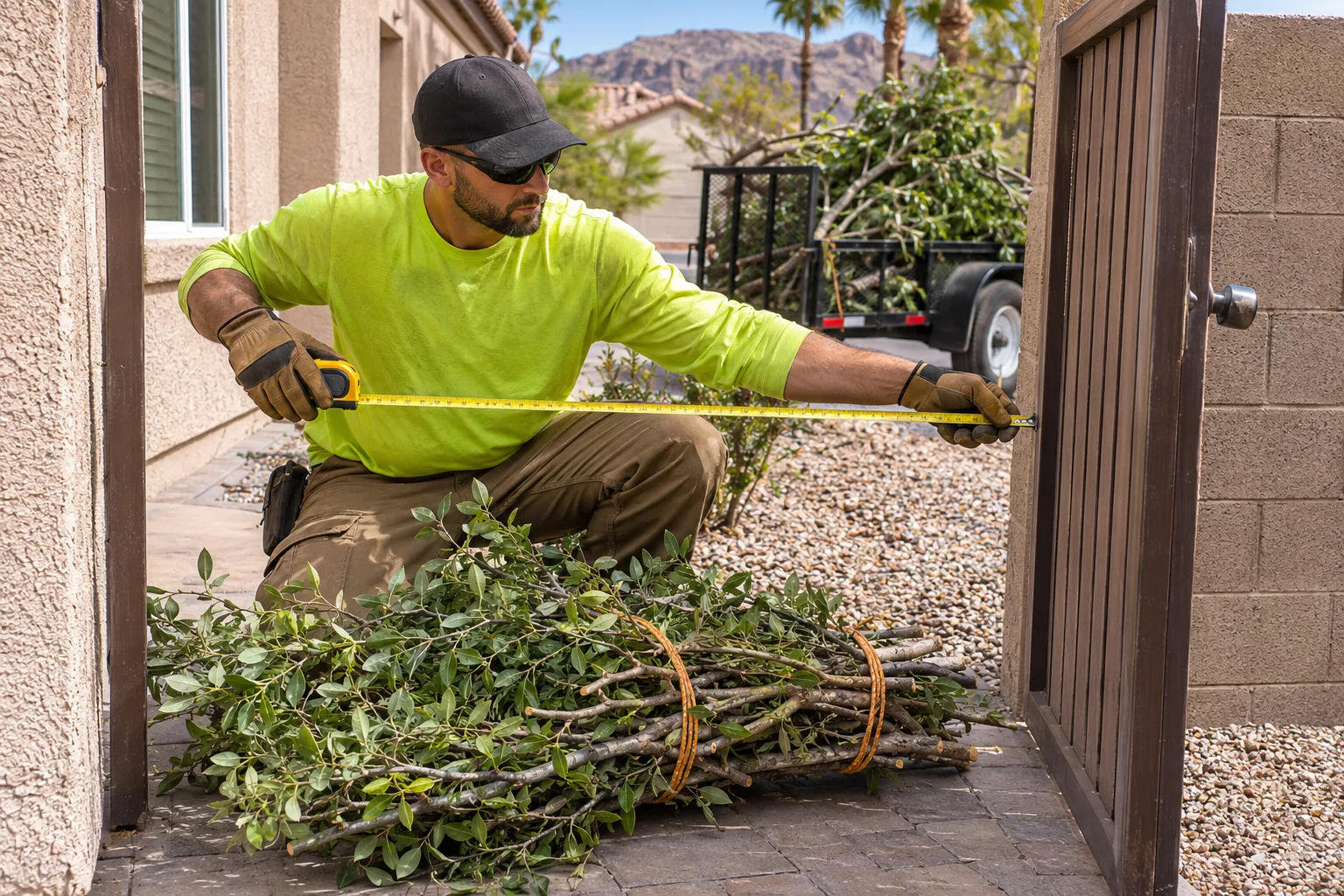
Place a tape measure beside the pile rather than climbing onto it. Record the longest visible branch, the approximate diameter of the thickest section and the overall pile length, width and height. If pieces are tangled, say so. Loose volume changes when branches are lifted.
| Photo | What it should show |
|---|---|
| Overall pile | All branch material and a fixed object for scale. |
| Largest pieces | Length, diameter and whether pieces are forked or tangled. |
| Exit route | Gate, turns, steps, slopes and anything that cannot move. |
| Loading point | Where a truck or trailer can stop without blocking unsafe areas. |
Keep the route plain and honest
Move toys, hoses and loose pots only when it is safe. Do not disconnect utility equipment or drag branches across fragile irrigation parts. Measure the gate at its narrowest clear opening, not post to post when hinges or latches reduce the usable width.
Bundling small pieces can help, but do not cinch a bundle so heavy that it cannot be lifted safely. Long, thorny or dense material may be easier to assess loose. Send the photos and measurements before doing extra cutting.
Bring this checklist to the estimate
- Longest branch and thickest diameter
- Approximate pile dimensions
- Power lines, hanging limbs or other hazards nearby
- Narrowest gate and number of turns
- Steps, slopes and loading distance
- Any thorns, wire or non-plant material in the pile
Review the branch and limb removal scope, then call with the pile and access details.